
Generating consistent leads is one of the biggest challenges businesses face in 2026.
A business can have a strong product, an experienced sales team, and an attractive website, but if potential customers cannot discover the brand or are not convinced to enquire, growth becomes difficult.
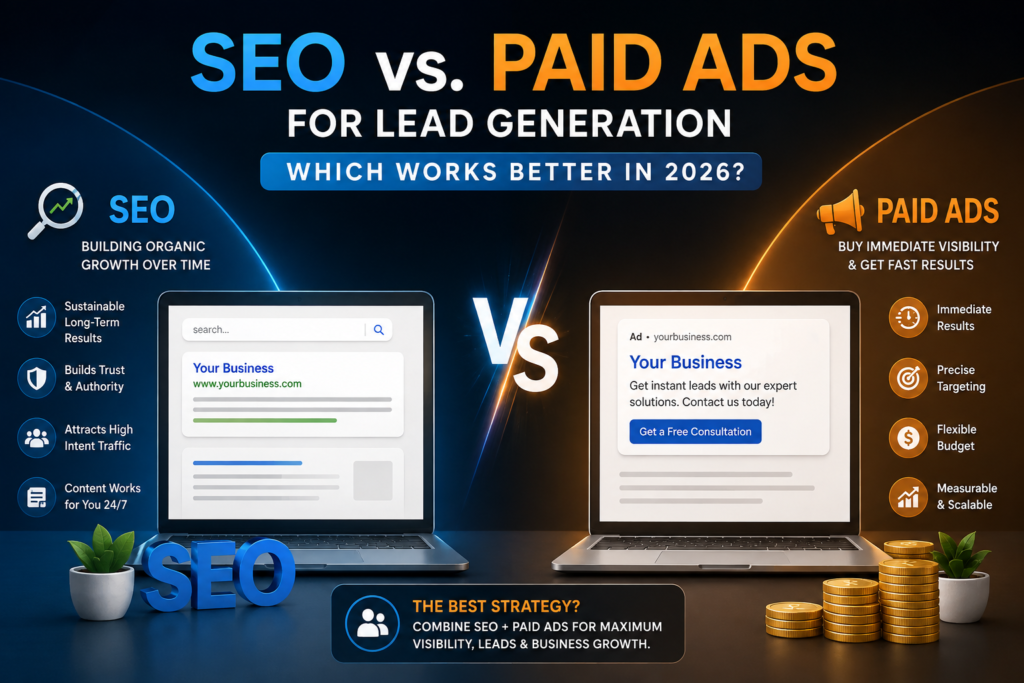
Two of the most widely used digital marketing channels for generating leads are SEO and paid advertising.
SEO helps businesses attract potential customers through organic search, while paid advertising allows businesses to pay for targeted visibility across search engines and digital platforms.
But which one works better for lead generation in 2026?
The answer depends on your business goals, budget, competition, sales cycle, customer acquisition cost, and how quickly you need results.
For most businesses, the better question isn’t simply SEO vs. paid ads. It’s understanding where each channel fits into the customer journey — and whether combining both can create a stronger lead-generation system.
What Is the Difference Between SEO and Paid Ads?
Before comparing the two strategies, it’s important to understand how they work.
What Is SEO?
Search engine optimisation (SEO) is the process of improving a website and its content so that it can appear more prominently in organic search results.
A strong SEO strategy can include:
- Keyword research
- Content creation
- On-page optimisation
- Technical SEO
- Internal linking
- Local SEO
- Website experience improvements
- Authority building
- Search-intent optimisation
- Content designed for AI-powered search experiences
The goal is to attract people who are already searching for information, products, or services related to your business.
For example, someone searching for “marketing consultant for business growth” already has a potential business need.
If your website provides a useful, credible answer and demonstrates relevant expertise, that search can become an opportunity to generate a qualified lead.
What Are Paid Ads?
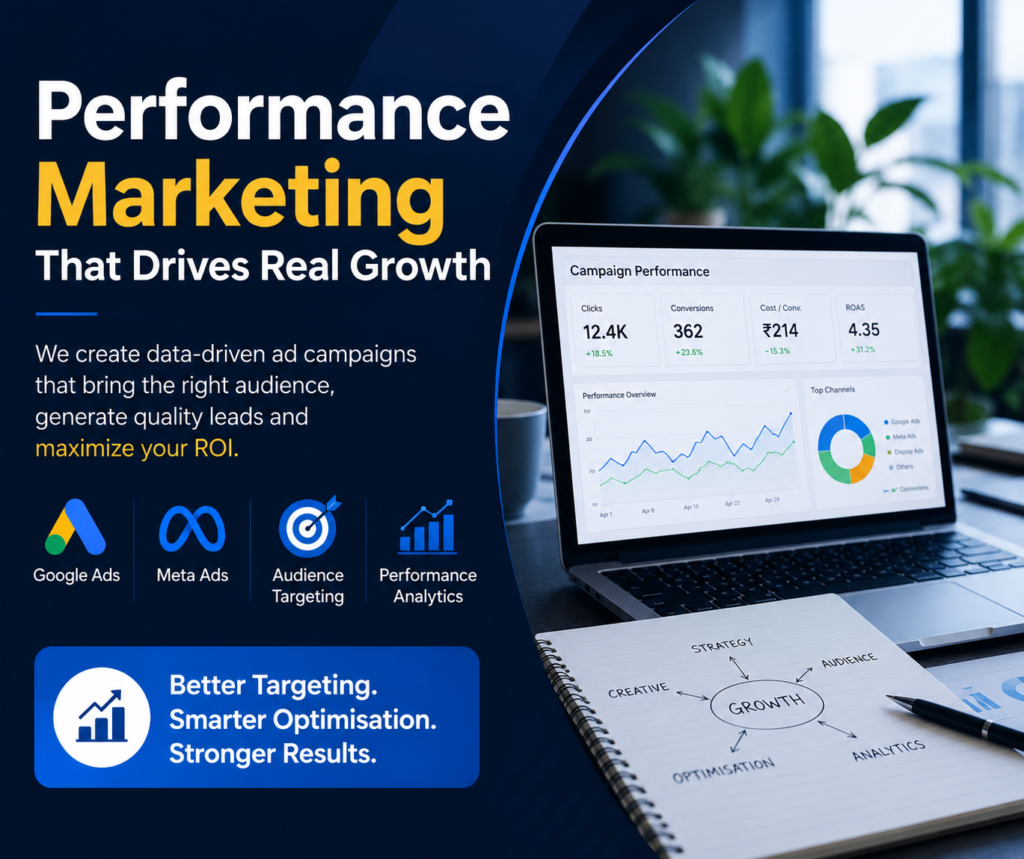
Paid advertising allows businesses to pay for targeted visibility across search engines, social media platforms, video platforms, and other digital channels.
Google Ads is one of the most common examples.
Businesses can target searches related to their products or services and send users to dedicated landing pages designed to generate enquiries.
Paid campaigns can also run across platforms such as:
- Google Search
- YouTube
- Display networks
The major advantage is control over targeting, budget, messaging, timing, and campaign optimisation.
SEO vs. Paid Ads for Lead Generation: The Key Difference
The simplest way to understand the difference is:
SEO builds organic visibility over time. Paid advertising buys immediate visibility.
SEO generally requires patience because rankings and organic authority take time to develop.
Paid ads can generate traffic much faster, but the traffic usually stops when advertising spend stops.
This creates an important distinction.
SEO is primarily a long-term acquisition asset.
Paid advertising is primarily a fast and controllable acquisition channel.
Neither is automatically better for every business.
How SEO Generates Leads
SEO can generate leads at different stages of the customer journey.
A potential customer may initially search for an educational topic such as:
“how to generate more B2B leads”
Later, the same person may search for:
“B2B lead generation consultant”
Eventually, they may search for a specific company or service.
A strong SEO strategy creates useful content for these different stages.
This means SEO isn’t simply about ranking for one keyword.
It’s about building visibility throughout the customer’s decision-making journey.
The biggest advantage of SEO
One of SEO’s biggest advantages is that useful content can continue attracting organic traffic after publication.
A successful article can potentially generate:
- Organic traffic
- Search visibility
- Brand awareness
- Leads
- Backlinks
- Referral traffic
- Returning visitors
This makes SEO particularly valuable for businesses looking to build sustainable customer acquisition.
How Paid Ads Generate Leads
Paid advertising works differently.
Instead of waiting for organic rankings, businesses pay for targeted exposure.
For example, a business consultant could create campaigns targeting searches such as:
- Business growth consultant
- Marketing consultant
- Business strategy consultant
- Lead generation consultant
The advertisement can then direct potential customers to a relevant landing page.
This gives businesses control over:
- Audience targeting
- Location
- Budget
- Search terms
- Ad messaging
- Landing pages
- Conversion tracking
The biggest advantage is speed.
A properly structured campaign can start generating traffic shortly after launch.
However, speed does not automatically mean profitability.
A campaign can generate hundreds of clicks while producing very few qualified enquiries.
That is why businesses should measure cost per qualified lead and customer acquisition cost, not just clicks.
SEO vs. Paid Ads: Which Is Faster?
If speed is the priority, paid advertising generally has the advantage.
SEO takes time because search engines need to discover, understand, evaluate, and rank content.
The timeline can vary significantly depending on:
- Website authority
- Competition
- Search demand
- Content quality
- Technical SEO
- Industry
- Search intent
Paid advertising doesn’t require waiting for organic rankings.
Businesses can create campaigns, set budgets, select audiences, and begin testing.
But faster traffic doesn’t necessarily mean better results.
The real question should be:
How quickly can the channel generate profitable, qualified customers?
SEO vs. Paid Ads: Which Is More Cost-Effective?
This is where the comparison becomes more complicated.
SEO and paid advertising have different cost structures.
SEO investment can include:
- Strategy
- Content
- Technical optimisation
- SEO specialists
- Digital PR
- Website improvements
- Authority building
Paid advertising can include:
- Ad spend
- Campaign management
- Creative development
- Landing pages
- Tracking
- Conversion optimisation
Paid advertising can therefore deliver immediate visibility, but continued visibility requires ongoing advertising expenditure.
SEO can require significant upfront investment, but successful organic visibility can continue generating traffic without paying for every individual click.
Don’t measure marketing by traffic alone
Businesses should compare:
- Cost per lead
- Cost per qualified lead
- Customer acquisition cost
- Lead-to-customer conversion rate
- Customer lifetime value
- Marketing ROI
A channel generating 1,000 visitors isn’t automatically better than one generating 100 visitors.
If those 100 visitors generate significantly more qualified customers, the smaller traffic source may be far more valuable.
Which Generates Better-Quality Leads?
Lead quality depends heavily on search intent, targeting, messaging, positioning, and conversion strategy.
SEO can generate highly qualified leads when content matches commercial search intent.
For example:
“What is digital marketing?”
is primarily informational.
But:
“Digital marketing consultant for my business”
shows stronger commercial intent.
The same principle applies to paid advertising.
A poorly targeted campaign can generate many leads that aren’t a good fit for the business.
Therefore, businesses should optimise both SEO and paid campaigns around intent and lead quality, rather than simply traffic volume.
SEO vs. Google Ads: Which Should a New Business Choose?
For a new business, paid advertising can be useful when immediate visibility is important.
A new website may not yet have enough organic authority to compete for highly competitive keywords.
Paid campaigns can help businesses test:
- Offers
- Keywords
- Audiences
- Landing pages
- Messaging
- Pricing
- Conversion rates
The data generated through these campaigns can then inform longer-term SEO and content decisions.
At the same time, new businesses shouldn’t become completely dependent on advertising.
Building organic visibility early can create a stronger acquisition foundation for the future.
When SEO Is the Better Choice
SEO may be the stronger option when:
1. You Want Sustainable Traffic
Businesses looking for long-term organic visibility should consider SEO as a core acquisition channel.
2. Your Customers Actively Search for Your Services
SEO becomes particularly valuable when potential customers regularly use search engines to research problems and solutions.
3. Your Customer Acquisition Costs Are Increasing
If paid advertising becomes increasingly expensive, organic acquisition can provide another source of qualified traffic.
4. You Have Valuable Expertise
Businesses with genuine expertise can turn their knowledge into useful content that attracts potential customers.
5. Your Sales Cycle Is Longer
SEO can help customers discover, research, compare, and evaluate your business before they are ready to contact sales.
When Paid Ads Are the Better Choice
Paid advertising may be more appropriate when:
1. You Need Leads Quickly
Paid campaigns can provide faster visibility than waiting for organic rankings.
2. You’re Launching a New Product
Paid advertising can help generate initial awareness and test market response.
3. You Have a Time-Sensitive Offer
Events, webinars, launches, promotions, and seasonal campaigns can benefit from paid reach.
4. You Know Your Target Audience
Strong audience data can make paid campaigns more efficient.
5. You Have a Proven Conversion Funnel
If your landing pages and sales process already convert effectively, paid traffic can help scale acquisition.
Should Businesses Use SEO and Paid Ads Together?
In many cases, yes.
Instead of treating SEO and paid advertising as competing channels, businesses can use them together:
SEO → Long-term organic visibility
Paid Ads → Immediate targeted traffic
Content → Education and trust
Landing Pages → Conversion
CRM → Lead management
Sales Follow-up → Lead nurturing
This creates a complete lead-generation system rather than relying on one traffic source.
For businesses looking beyond individual campaigns and trying to create a predictable acquisition system, building a scalable customer acquisition strategy becomes an important part of sustainable growth.
How SEO and Paid Ads Can Support Each Other
The data from paid campaigns can help inform SEO decisions.
Suppose a paid campaign reveals that a particular keyword generates highly qualified leads.
That keyword may deserve greater attention in the organic SEO strategy.
Similarly, SEO data can reveal which topics and search queries are attracting strong engagement.
Those insights can then be tested through paid campaigns.
This creates a feedback loop:
Paid data → SEO insights → Content → Organic traffic → Conversion data → Paid optimisation
Instead of operating SEO and paid advertising in separate silos, businesses can use the data from both channels to improve the overall acquisition strategy.
What About AI Search in 2026?
Search behaviour is changing rapidly.
Customers are increasingly using AI-powered search and digital assistants to research businesses, compare solutions, and answer questions.
That means businesses shouldn’t think about SEO only as traditional keyword ranking.
Content should be:
- Useful
- Clear
- Specific
- Well structured
- Trustworthy
- Easy to understand
- Based on genuine expertise
- Focused on customer questions
This is where Answer Engine Optimisation (AEO) becomes increasingly relevant.
Businesses should ask not only:
“How do I rank this page?”
but also:
“Does this page provide the clearest and most useful answer to the customer’s question?”
For businesses looking at AI beyond content and search, building an AI strategy for business in 2026 can help connect AI adoption with broader business objectives.
Why More Marketing Spend Doesn’t Always Mean More Leads
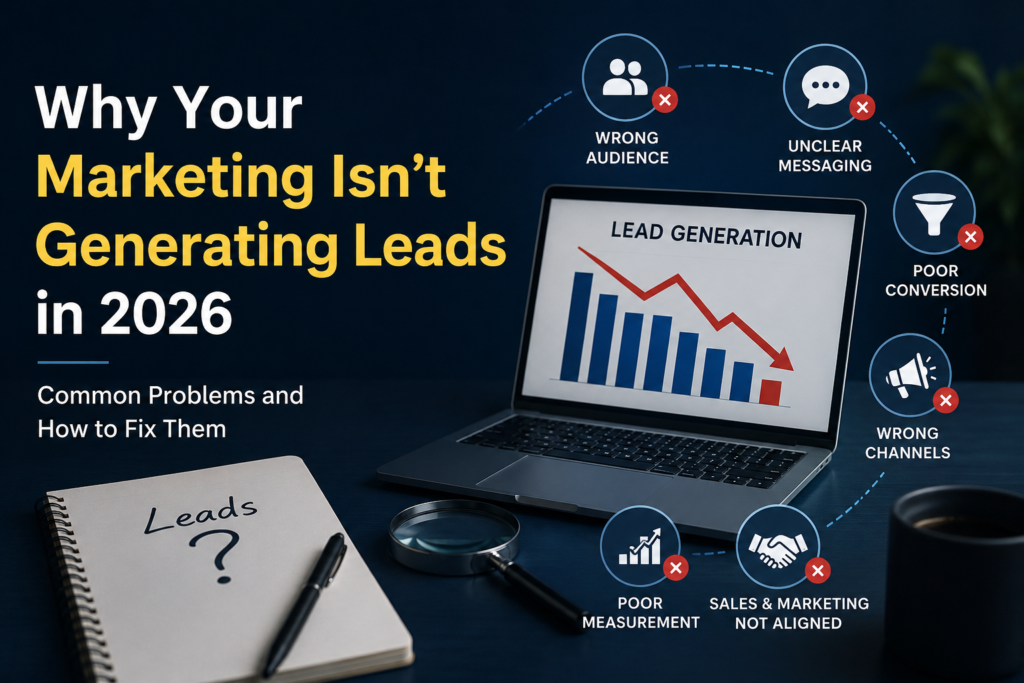
One of the biggest mistakes businesses make is assuming that increasing their marketing budget will automatically increase leads.
It doesn’t.
If the underlying strategy is weak, increasing traffic can simply increase the number of visitors who don’t convert.
Common problems include:
- Weak positioning
- Poor landing pages
- Incorrect audience targeting
- Generic content
- Slow lead response
- Poor lead qualification
- Weak follow-up systems
- Inaccurate conversion tracking
This is why fixing the underlying marketing system can be more important than simply increasing the budget.
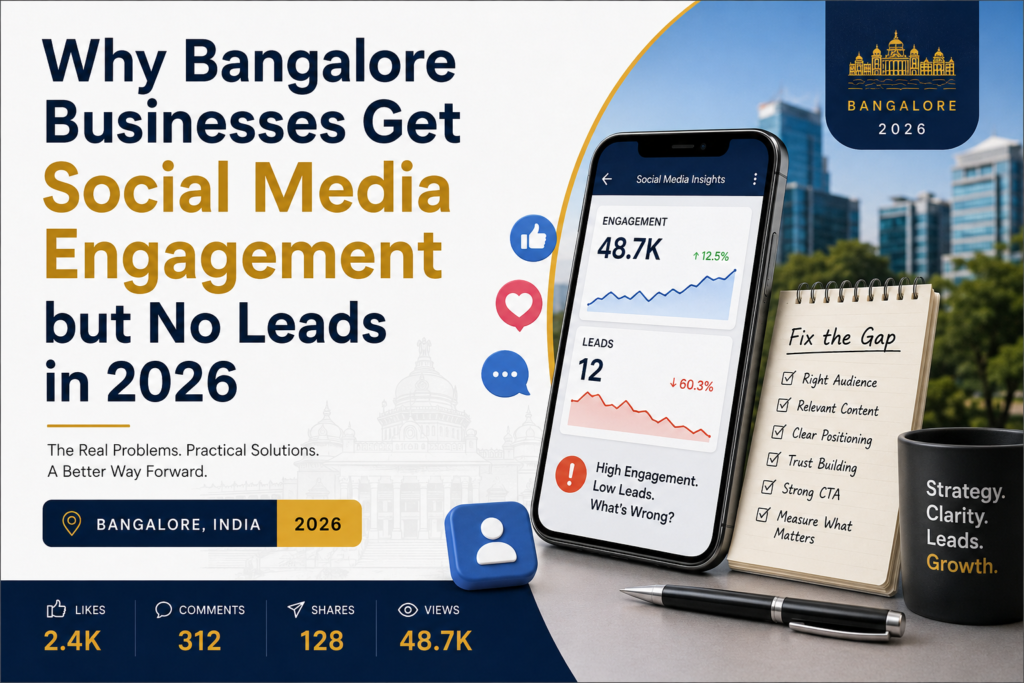
If your business is investing in SEO, paid advertising, social media, or content but still isn’t generating enough enquiries, understanding why marketing isn’t generating leads in 2026 can help identify some of the common gaps.
SEO, Paid Ads and Business Growth
Lead generation shouldn’t exist separately from the wider business strategy.
A company can generate thousands of leads and still struggle to grow if:
- Leads aren’t qualified
- Sales conversion is weak
- Customer retention is poor
- Acquisition costs are too high
- Operations cannot handle new customers
- The business lacks scalable processes
This is why marketing acquisition should connect directly with broader business-growth objectives.
A strong growth strategy should consider:
Demand generation + Lead quality + Sales conversion + Retention + Profitability
Businesses planning to expand should therefore look beyond traffic and leads and evaluate whether their entire customer acquisition system is scalable.
For a deeper look at this, see How to Scale Your Business in 2026.
When Should You Consider a Marketing Consultant?
Not every business needs external consulting.
However, strategic support can become valuable when:
- Growth has stalled
- Marketing costs are increasing
- Lead quality is declining
- Multiple acquisition channels aren’t working together
- Sales and marketing teams aren’t aligned
- The business is preparing to scale
- Leadership isn’t sure where to allocate marketing budget
A marketing consultant can help identify gaps across positioning, customer acquisition, conversion, marketing ROI, and growth strategy.
For businesses considering strategic support before expansion, why businesses need a marketing consultant before scaling is worth exploring.
A Practical Lead Generation Strategy for 2026
Instead of asking whether SEO or paid ads are better, businesses can build their strategy around four stages.
Stage 1: Build the Foundation
Start with:
- Clear positioning
- Defined target audience
- Strong website
- Conversion-focused landing pages
- Analytics
- CRM
- Conversion tracking
Stage 2: Build Organic Visibility
Develop:
- Service pages
- Problem-solving articles
- Commercial content
- Informational content
- Internal links
- Local SEO where relevant
- AEO-focused content
Stage 3: Use Paid Ads Strategically
Run targeted campaigns to:
- Test demand
- Generate immediate leads
- Promote high-value services
- Retarget website visitors
- Support launches and campaigns
Stage 4: Measure Business Outcomes
Track:
- Leads
- Qualified leads
- Conversion rate
- Cost per lead
- Customer acquisition cost
- Revenue generated
- Customer lifetime value
- Marketing ROI
This prevents businesses from judging marketing success purely through impressions, clicks, or rankings.
SEO vs. Paid Ads: Which Works Better in 2026?
There is no universal winner.
Choose SEO when your priority is long-term organic growth, sustainable visibility, and building an acquisition asset that can continue producing value.
Choose paid ads when your priority is speed, immediate visibility, controlled targeting, and testing offers or audiences quickly.
Use both when you want to build a diversified lead-generation system.
For many businesses, the strongest approach is:
SEO for long-term growth + Paid Ads for immediate opportunities + Conversion optimisation for turning traffic into revenue.
The goal isn’t to generate the most traffic.
The goal is to generate the right traffic, convert qualified prospects, and build a predictable customer acquisition system.
The real question isn’t:
“SEO or paid ads?”
It’s:
“What combination of channels can generate qualified leads profitably and sustainably for my business?”
Frequently Asked Questions
Is SEO better than paid ads for lead generation?
SEO can be better for sustainable long-term lead generation, while paid ads can be better when immediate leads are required. The right choice depends on business goals, competition, budget, and customer acquisition economics.
Is SEO cheaper than paid advertising?
SEO doesn’t necessarily have a lower upfront cost. However, successful organic visibility can continue generating traffic without paying for every individual click. Paid advertising requires ongoing ad spend to maintain visibility.
How long does SEO take to generate leads?
The timeline varies based on the website, competition, content quality, authority, search demand, and industry. SEO should generally be treated as a long-term growth strategy rather than an instant lead-generation channel.
How quickly can paid ads generate leads?
Paid advertising can begin generating traffic soon after campaigns launch, but lead generation depends on targeting, offer quality, landing-page experience, competition, budget, and conversion rates.
Can SEO and paid ads work together?
Yes. Businesses can use paid advertising for immediate traffic and testing while building SEO for long-term organic visibility. Data from each channel can also improve the other.
Which is better for a small business in 2026?
It depends on the business. Paid advertising can help generate immediate demand, while SEO can build sustainable organic visibility. A combination can be effective when the business has the resources and conversion systems to manage both properly.
Final Takeaway
SEO and paid advertising shouldn’t be viewed as opposing strategies.
They solve different problems.
Paid advertising provides speed and control.
SEO provides the opportunity to build sustainable organic visibility.
The strongest strategy isn’t always about choosing one over the other. It’s about understanding where each channel fits within the customer’s journey and measuring the business outcomes that follow.
In 2026, businesses that combine SEO, paid advertising, useful content, conversion optimisation, accurate measurement, and AI-aware search strategies can build a stronger foundation for predictable lead generation.
The real question is not:
“SEO or paid ads?”
It is:
“What combination of channels can generate qualified leads profitably and sustainably for my business?”