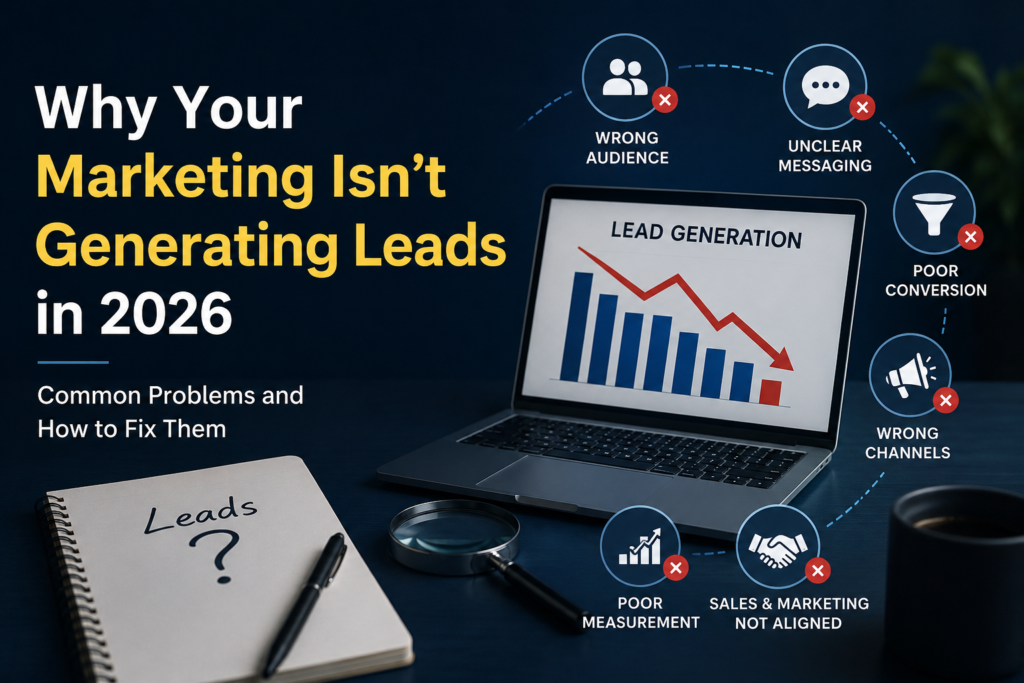

If your business is investing in SEO, paid advertising, social media, content, or other digital marketing channels but still isn’t generating enough leads, the problem may not be your marketing budget.
In many cases, businesses are attracting visitors but failing to reach the right audience, communicate their value clearly, convert website visitors, or follow up with potential customers effectively.
In 2026, the challenge has become more complex. Customers are discovering businesses through search, AI-powered experiences, social platforms, reviews, communities, and multiple digital touchpoints before making a decision.
So, why is your marketing not generating leads?
The answer usually comes down to a combination of strategy, targeting, messaging, conversion, and measurement.
Why Is Your Marketing Not Generating Leads in 2026?
Generating leads isn’t simply about getting more traffic.
A business can receive thousands of website visits and still generate very few enquiries if those visitors aren’t the right audience or if the website doesn’t give them a clear reason to take action.
A strong lead-generation strategy needs to connect several stages:
Right audience → Clear positioning → Relevant marketing channel → Useful content → Strong conversion experience → Lead nurturing → Measurement
If one of these stages is weak, the entire marketing funnel can suffer.
This is why marketing strategy should be connected to broader business objectives rather than treated as a collection of disconnected campaigns. Dr. Nishant Jayant’s approach to Marketing Strategy & Performance focuses on campaign architecture, brand positioning, consumer psychology, performance marketing, and measurable ROI.
1. You’re Targeting the Wrong Audience
One of the biggest marketing lead generation problems is targeting too broadly.
Businesses often try to reach as many people as possible instead of identifying the people most likely to become customers.
For example, a B2B company may generate thousands of impressions through social media but very few qualified leads because its campaigns aren’t reaching decision-makers.
Before increasing your advertising budget or publishing more content, ask:
- Who is your ideal customer?
- What problem are they trying to solve?
- What triggers them to search for a solution?
- What factors influence their buying decision?
- Which platforms do they actually use?
Understanding buyer intent is particularly important.
Someone searching for general information isn’t necessarily ready to buy. Someone comparing providers, requesting pricing, or searching for a specific solution may have much stronger commercial intent.
Your marketing should account for these differences.
For startups and growing companies, this also connects closely with Startup & SME Acceleration, where the focus is on market penetration, competitive differentiation, and structured growth.
2. Your Marketing Message Isn’t Clear Enough
Even when you’re reaching the right audience, your marketing may fail if people don’t immediately understand what you offer and why it matters.
A common mistake is filling websites and advertisements with generic statements such as:
“Delivering innovative solutions for modern businesses.”
That may sound professional, but it doesn’t tell the customer what problem you solve.
Effective messaging should answer three simple questions:
What do you offer?
Who is it for?
Why should they choose you?
Your value proposition should be clear across your website, landing pages, advertisements, social media profiles, and other customer touchpoints.
When your positioning is unclear, potential customers have less reason to continue exploring your business.
3. You’re Getting Traffic but Not Conversions
Another common situation is having reasonable website traffic but very few enquiries.
This usually means there’s a gap between acquisition and conversion.
Getting someone to your website is only the first step.
If the landing page is confusing, slow, difficult to navigate, or doesn’t provide a clear next step, visitors may leave without contacting you.
Review your website for:
- Clear headlines
- Strong value propositions
- Relevant landing pages
- Visible calls to action
- Simple enquiry forms
- Trust signals
- Customer testimonials
- Case studies
- Mobile usability
- Fast page loading
A simple CTA such as “Book a Consultation,” “Request a Quote,” or “Talk to an Expert” can be more effective than a vague “Learn More,” provided it matches the user’s intent.
Google also recommends focusing on helpful, people-first content and a good overall page experience rather than creating content simply to manipulate search rankings.
4. You’re Using the Wrong Marketing Channels
Not every marketing channel is suitable for every business.
A B2B consultancy, ecommerce company, local service provider, and consumer brand may need completely different acquisition strategies.
For example, SEO can help businesses capture people actively searching for solutions. Paid search can target high-intent queries. Social media can support awareness and engagement. Email can help nurture existing prospects.
The goal isn’t to be everywhere.
The goal is to identify where your potential customers are most likely to discover, evaluate, and choose your business.
Review your current channels and ask:
Which channels generate qualified leads rather than just impressions, clicks, or followers?
That distinction can completely change how you allocate your marketing budget.
This is particularly relevant when building a broader Business Growth Consulting strategy, where marketing needs to support sustainable growth rather than operate independently.
5. Your Content Gets Attention but Doesn’t Create Demand
Traffic and engagement can look impressive in a marketing report, but they don’t necessarily translate into revenue.
A blog post might receive thousands of views while generating almost no business enquiries.
This happens when content is created primarily for traffic instead of customer needs.
Effective content should help potential customers:
- Understand a problem
- Compare possible solutions
- Evaluate providers
- Make informed decisions
- Understand the value of your offering
A strong content strategy should cover different stages of the customer journey.
For example:
Awareness: What is the problem?
Consideration: What solutions are available?
Decision: Which solution or provider is right?
Action: What should the customer do next?
This approach is also consistent with Google’s current guidance, which emphasizes original, useful, reliable, people-first content rather than content produced primarily to attract search traffic.
For more perspective on scaling, readers can also explore “The Growth Framework Every Business Needs to Scale Faster and Smarter” from Dr. Nishant Jayant’s Insights section.
6. You’re Not Using Data to Improve Marketing Performance
If you’re not measuring the right metrics, it’s difficult to know why your marketing isn’t generating leads.
Website traffic alone isn’t enough.
Businesses should understand what happens after a visitor arrives.
Important metrics include:
- Qualified leads
- Conversion rate
- Cost per lead
- Customer acquisition cost
- Lead-to-customer rate
- Conversion rate by channel
- Marketing ROI
- Landing page performance
For example, suppose one channel produces 1,000 visitors and another produces 300.
At first glance, the first channel looks better.
But if the first produces five qualified leads while the second produces 25, the smaller channel may actually be much more valuable.
The objective should therefore be business outcomes, not vanity metrics.
Google Ads similarly recommends conversion tracking to understand which ads, keywords, and campaigns contribute to meaningful actions such as leads and sales.
7. Your Marketing and Sales Teams Aren’t Aligned
Sometimes marketing is generating leads, but the business still feels that marketing isn’t working.
The problem may actually be what happens after the lead arrives.
If marketing and sales have different definitions of a qualified lead, potential customers can fall through the cracks.
A better process connects:
Marketing → Lead qualification → Sales follow-up → Nurturing → Conversion
Businesses should establish clear criteria for what constitutes a qualified lead and make sure sales teams receive enough context to have a relevant conversation.
This is especially important as advertising platforms increasingly support deeper funnel measurement, including qualified and converted lead goals.
How AI Is Changing Lead Generation in 2026
AI is changing how businesses approach marketing, but it shouldn’t replace marketing strategy.
Businesses can use AI to support areas such as:
- Customer and audience research
- Personalization
- Content analysis
- Lead qualification
- Campaign optimization
- Marketing automation
- Customer insights
- Predictive analysis
AI-powered search is also changing how customers discover information.
However, businesses shouldn’t assume that AI search requires a completely separate SEO strategy.
Google’s current guidance states that the fundamental SEO practices remain important for AI features such as AI Overviews and AI Mode, including making content discoverable through internal links, maintaining strong technical SEO, and creating useful textual content.
This is where Dr. Nishant Jayant’s AI & Digital Transformation expertise becomes relevant, particularly for businesses looking to adopt AI-first marketing workflows and automation while maintaining a broader strategic direction.
You can also explore the existing Insights article “How to Build an AI Strategy for Business in 2026” for a deeper look at the strategic side of AI adoption.
How to Build a Lead Generation Strategy That Works in 2026
Instead of randomly adding new marketing channels, build your strategy around the customer journey.
1. Define Your Ideal Customer
Identify the customers most likely to benefit from your product or service.
2. Understand Their Problems
Research the questions, frustrations, goals, and objections that influence their decisions.
3. Strengthen Your Positioning
Explain clearly why your business is relevant and different.
4. Choose the Right Channels
Focus your resources on channels where your target audience has meaningful buying intent.
5. Create Content for Each Stage
Develop content that helps customers move from awareness to consideration and eventually to action.
6. Improve Conversion Points
Make it easy for interested visitors to contact you, request information, book a consultation, or take the next relevant step.
7. Measure What Matters
Track qualified leads, conversions, acquisition costs, and revenue instead of focusing only on traffic and engagement.
8. Use AI Where It Adds Value
Automate repetitive work and use AI for analysis and optimization while keeping strategic decisions grounded in customer insight and business objectives.
For businesses going through this transition, Dr. Nishant Jayant’s existing Business Growth and AI & Digital Transformation expertise provides relevant supporting context.
What Should You Fix First If Your Marketing Isn’t Generating Leads?
Don’t immediately increase your advertising budget.
Start with a simple audit.
First, check your audience. Are you reaching people who can actually become customers?
Next, review your messaging. Can someone understand your value within a few seconds?
Then, check your conversion experience. Can visitors easily understand what to do next?
After that, evaluate your channels. Which sources are actually producing qualified opportunities?
Finally, review your measurement. Do you know which campaigns and channels are generating real business results?
Fixing these fundamentals can often produce better results than simply spending more money.
Final Thoughts
If your marketing isn’t generating leads in 2026, the answer isn’t always “do more marketing.”
Sometimes the real problem is targeting the wrong audience. Sometimes the messaging isn’t clear. Sometimes traffic isn’t converting. And sometimes the business simply isn’t measuring the right outcomes.
The most effective approach is to look at the entire customer journey and identify where potential customers are dropping out.
Marketing works best when strategy, customer understanding, content, technology, conversion, and measurement work together.
The focus should not simply be on generating more leads, but on generating better-qualified opportunities that can contribute to sustainable business growth.
If your business is struggling to connect marketing activity with measurable growth, exploring a strategic approach to business growth consulting can be a useful next step. Dr. Nishant Jayant works across marketing strategy, business growth, AI transformation, agency leadership, and startup/SME acceleration.
About Dr. Nishant Jayant
Dr. Nishant Jayant is a marketing strategist and business transformation leader with experience across business strategy, performance marketing, digital innovation, and growth. His website highlights work across areas including marketing strategy, business growth consulting, AI and digital transformation, PR and brand production, agency growth, and startup/SME acceleration.