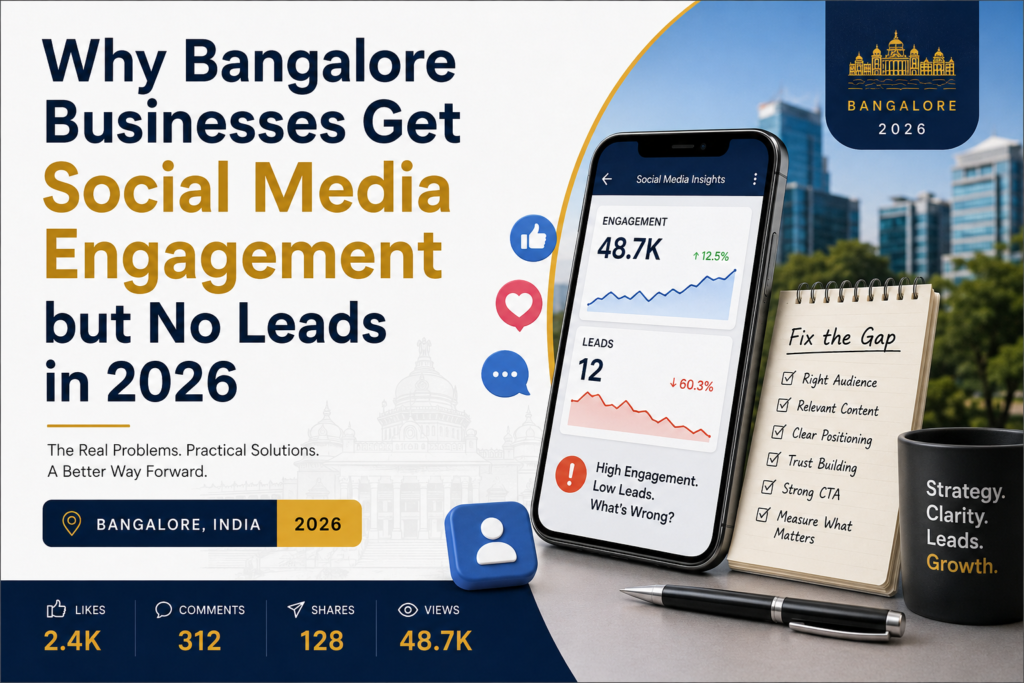

Your Instagram post gets hundreds of likes.
Your LinkedIn post receives comments.
A short video gets thousands of views.
But when you check your enquiries, there is almost nothing.
For many businesses in Bangalore, this is becoming a frustrating reality. Social media accounts look active, engagement numbers appear healthy, and content is being published consistently—but the business is still not generating enough qualified enquiries.
The immediate reaction is often:
“We need to post more.”
But posting more is rarely the real solution.
The bigger question is whether your social media activity is connected to a clear customer acquisition strategy.
In a competitive market like Bangalore, attention alone is not enough. Your content needs to reach the right audience, address a relevant problem, build trust, and give potential customers a logical next step.
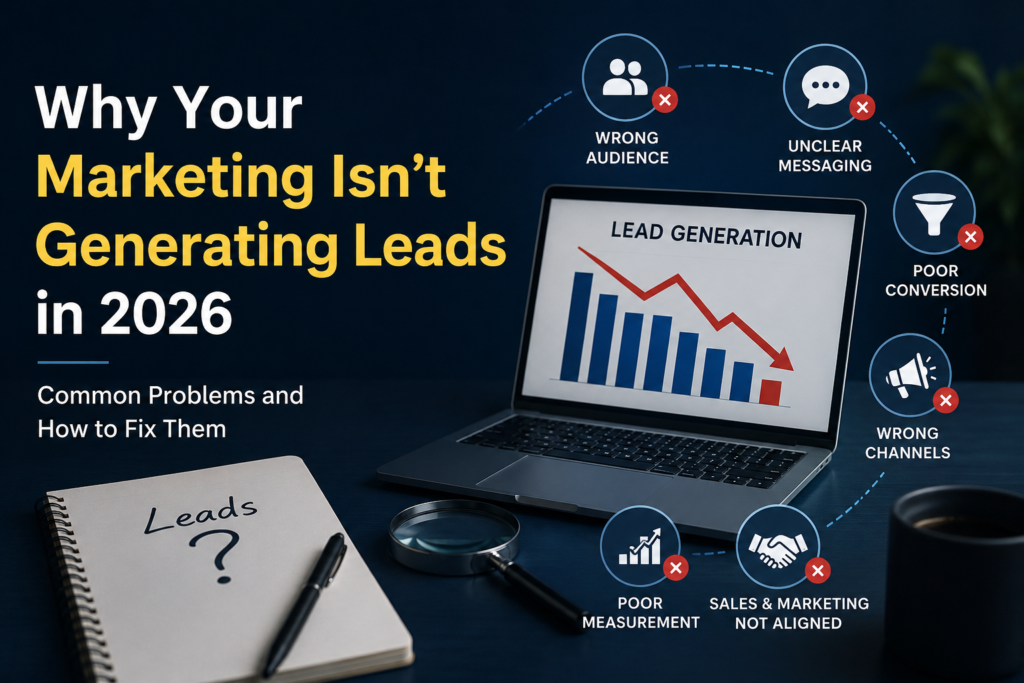
If your broader marketing activity is also struggling to convert attention into enquiries, it is worth looking at why your marketing isn’t generating leads in 2026.
This article looks specifically at social media and explains why engagement often fails to become leads—and what businesses can do differently in 2026.
Engagement Is Not the Same as Lead Generation
One of the biggest mistakes businesses make is treating engagement as proof that their social media strategy is working.
Likes, comments, shares, views and followers tell you that people are interacting with your content.
They don’t necessarily tell you that those people are interested in buying from you.
Consider two examples.
Business A publishes an entertaining video that receives 50,000 views.
Business B publishes a specific post explaining how its service solves an expensive problem for a particular type of customer. The post receives 2,000 views but generates 12 qualified enquiries.
Which campaign performed better?
For a business focused on revenue, Business B may have created significantly more value.
That is why social media should not be evaluated only through vanity metrics.
A stronger measurement framework looks at:
- Qualified enquiries
- Website visits from social media
- Conversion rate
- Cost per lead
- Lead quality
- Sales opportunities
- Customer acquisition cost
- Revenue generated
The goal isn’t to eliminate engagement.
The goal is to turn relevant engagement into meaningful business outcomes.
Problem 1: Your Content Is Designed for Everyone
One of the easiest ways to make social media ineffective is to create content for an audience that is too broad.
A Bangalore-based business might say:
“Our target audience is anyone who needs marketing.”
That’s not an audience.
A better approach is to identify:
- Who has the problem?
- How serious is the problem?
- What type of business do they operate?
- Who makes the purchasing decision?
- What triggers them to look for a solution?
- What objections prevent them from buying?
This is closely connected to brand positioning. If your audience and market position are unclear, your social media messaging will usually become broad as well.
A strong brand positioning strategy helps create a clearer value proposition, audience definition, messaging hierarchy and competitive differentiation.
For example, a marketing consultant targeting founders of growing B2B companies should not communicate in exactly the same way as a consumer brand targeting young Instagram users.
The platform may be similar.
The buyer journey is not.
How to fix it
Create content around specific customer problems rather than generic industry topics.
Instead of:
“5 Social Media Tips for Businesses”
Try:
“Why Your B2B LinkedIn Content Gets Views but No Sales Conversations”
The second topic speaks to a specific audience with a specific problem.
That makes the content more relevant—and relevance is far more valuable than simply increasing reach.
Problem 2: Your Content Gets Attention From the Wrong People
Another common problem is attracting people who are interested in the content but have no reason to become customers.
This happens frequently when businesses chase viral content.
A funny or highly shareable post might generate excellent engagement, but if the people engaging with it have no connection to your product or service, the commercial value may be limited.
This doesn’t mean every post needs to sell.
It means your overall content strategy needs to attract the right type of attention.
A useful content mix can include:
Discovery Content
Designed to reach people who may not know your business.
Examples:
- Industry observations
- Common mistakes
- Short educational videos
- Trends
- Problem-focused posts
Trust Content
Designed to demonstrate expertise.
Examples:
- Case studies
- Detailed explanations
- Frameworks
- Lessons from real projects
- Founder insights
- Data-backed analysis
Conversion Content
Designed to move interested people toward action.
Examples:
- Service explanations
- Client outcomes
- FAQs
- Comparisons
- Consultation-related content
- Strong problem-solution posts
When these three layers work together, social media becomes part of a customer journey instead of a collection of disconnected posts.
Problem 3: You’re Educating People but Not Helping Them Take the Next Step
Educational content is important.
But some businesses stop there.
They publish useful information week after week but never create a bridge between the information and the solution they provide.
Imagine someone reading:
“7 Reasons Your Marketing Campaign Isn’t Generating Leads.”
They find the article useful.
But what happens next?
If there is no logical next step, the interaction ends.
How to fix it
Every piece of content doesn’t need a sales pitch.
Instead, use contextual calls to action.
For example:
- Read the complete guide
- Explore the related service
- See how the process works
- Read a relevant case study
- Book a strategy discussion
The CTA should match the reader’s level of intent.
Someone discovering your brand for the first time may not be ready to book a consultation.
Someone who has consumed several educational posts and is actively researching a solution may be.
Good social media strategy respects that difference.
Problem 4: Your Profile Is Getting Visits but Not Converting Them
Your content may be doing its job.
People discover you.
They become curious.
They visit your profile.
And then the journey stops.
Why?
Because the profile doesn’t clearly answer three basic questions:
Who are you?
Who do you help?
What should someone do next?
Your social profile should make your positioning obvious within seconds.
Review:
- Profile description
- Value proposition
- Target audience
- Website link
- Contact options
- Relevant services
- Proof of expertise
- Case studies
- Featured content
Don’t make potential customers work to understand what your business does.
Clarity reduces friction.
Problem 5: Your Social Media and Website Are Working Separately
This is a major issue.
A business may invest heavily in social media content but treat the website as a completely separate channel.
That creates a broken customer journey.
A potential customer sees a LinkedIn post.
They click your profile.
They visit your website.
Then they cannot immediately find the information promised in the post.
The result is lost intent.
Your social content and website should support each other.
For example:
Social post → Relevant article → Service page → Enquiry
Or:
Social post → Case study → Consultation
This is also where content becomes valuable.
Your blog can answer a user’s question before they ever speak to the sales team.
The same principle appears in Dr. Nishant’s broader approach to marketing strategy consulting, where marketing activity is connected to business objectives, customer acquisition and measurable performance rather than being treated as isolated campaigns.
Problem 6: Your Content Talks About Your Business Too Much
People don’t open social media because they want to read endless advertisements.
They are looking for information, opinions, ideas, entertainment, solutions and perspectives.
If every post says:
“We offer…”
“Our services include…”
“Contact us today…”
the audience has little reason to continue paying attention.
A stronger approach is to start with the customer’s problem.
Instead of:
“We provide digital marketing services in Bangalore.”
Consider:
“Your marketing budget isn’t necessarily the problem. If qualified leads are declining while traffic is increasing, your conversion journey may be broken.”
The second message creates curiosity because it addresses a business concern.
Then your expertise becomes relevant naturally.
Problem 7: You’re Not Building Enough Trust
A potential customer rarely moves from seeing one social post to making a significant purchase decision.
Especially for consulting, professional services, B2B solutions and high-value offerings, trust matters.
People want evidence that you understand their problem.
That is why businesses should use social media to demonstrate expertise rather than simply announce expertise.
Show:
- How you think
- How you analyse problems
- What mistakes you have observed
- What patterns you see in the market
- What businesses should measure
- What strategies work
- What strategies fail
- Lessons from experience
- Real examples where appropriate
This is where thought leadership becomes valuable.
Dr. Nishant’s existing content around business growth trends in 2026 also highlights the growing importance of brand positioning, customer relationships, data-driven decisions and personal branding in sustainable business growth.
Social media can become the channel through which that expertise is consistently demonstrated.
Problem 8: You’re Measuring the Wrong Numbers
If your monthly social media report starts and ends with:
Followers: +2,000
Likes: +15,000
Reach: +500,000
you still don’t know whether social media is helping the business.
A better reporting structure connects social activity to the funnel.
Awareness
- Reach
- Impressions
- Video views
- Profile visits
Engagement
- Comments
- Shares
- Saves
- Engagement rate
Intent
- Website clicks
- Service-page visits
- Content downloads
- Enquiry-page visits
Conversion
- Leads
- Qualified leads
- Sales opportunities
- Customers
- Revenue
The exact metrics will vary by business.
A B2B company may care more about qualified conversations than follower growth.
A D2C business may care more about purchases and repeat customers.
A professional service business may care about consultation requests.
The KPI should follow the business model—not the platform.
This measurement-first approach also aligns with Dr. Nishant’s broader business growth consulting framework, which emphasizes measurable outcomes and regular KPI reviews.
Problem 9: You’re Expecting Social Media to Do the Entire Job
Social media is one part of the marketing system.
It doesn’t have to do everything.
A customer may discover your brand through Instagram, research you through Google, read your blog, check LinkedIn, visit your website, compare alternatives and contact you several days later.
That means attribution can become complicated.
Instead of asking:
“Did Instagram generate this customer?”
ask:
“How did social media contribute to this customer’s journey?”
This creates a more realistic view of marketing performance.
SEO, content, social media, paid advertising, email, sales and customer experience should not operate as completely independent systems.
They should reinforce each other.
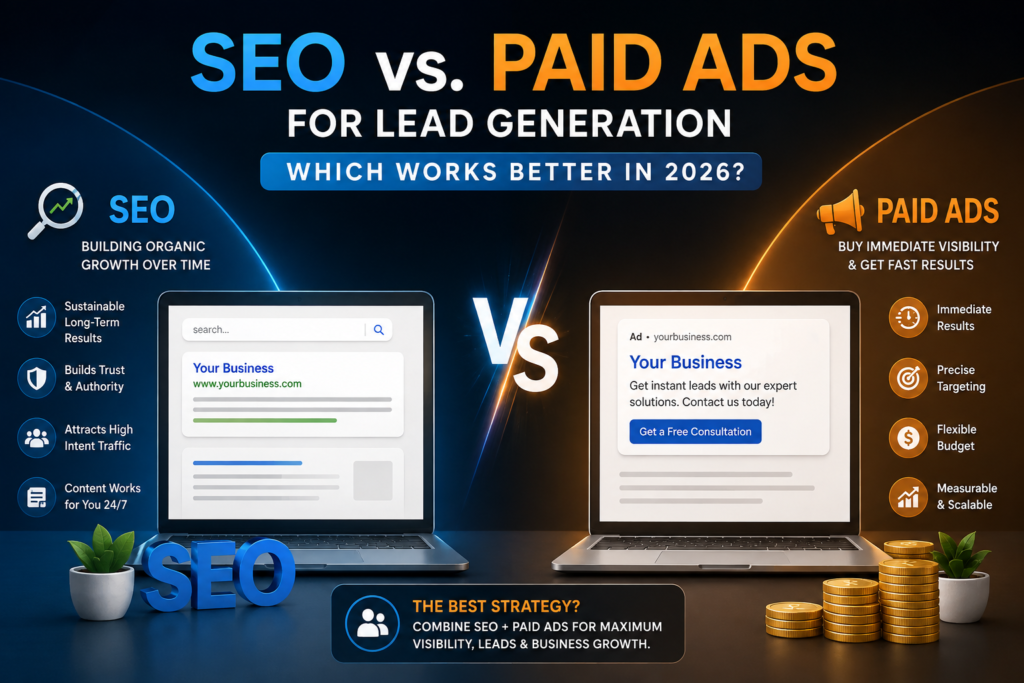
For businesses comparing different acquisition channels, Dr. Nishant’s article on SEO vs. Paid Ads for lead generation in 2026 can be used as a related resource when that article is available under its current published URL.
A Practical Social Media Lead-Generation Framework for Bangalore Businesses
If your social media is generating attention but not enough enquiries, start with this five-step framework.
Step 1: Identify One High-Value Customer Problem
Don’t begin with:
“What should we post today?”
Begin with:
“What problem is our ideal customer actively trying to solve?”
Build content around that problem.
Step 2: Create Content Around the Buying Journey
Develop content for different stages:
Problem awareness → Education → Trust → Evaluation → Action
This prevents your feed from becoming a collection of random tips.
Step 3: Connect Content to a Destination
Every important content theme should have somewhere useful to send interested people.
That might be:
- A blog
- A service page
- A case study
- A landing page
- A lead form
- A consultation page
Step 4: Build a Clear CTA
Don’t make every CTA:
“Contact us now.”
Match the CTA to intent.
For example:
Low intent: Read the full guide.
Medium intent: Explore how the strategy works.
High intent: Book a consultation.
Step 5: Measure Business Outcomes
Review social performance alongside:
- Website traffic
- Leads
- Qualified leads
- Conversion rate
- Sales pipeline
- Customer acquisition cost
- Revenue
This tells you whether the strategy is actually contributing to growth.
A 30-Minute Social Media Audit You Can Do Today
If you believe your social media isn’t generating enough leads, don’t immediately increase your content budget.
Spend 30 minutes answering these questions.
Audience
- Who exactly are we trying to reach?
- Are our recent posts attracting that audience?
- Are we speaking about their problems?
Content
- Which posts generated meaningful conversations?
- Which posts generated only passive engagement?
- Are we publishing enough trust-building content?
- Are we explaining problems in enough depth?
Conversion
- Is our profile clear?
- Is the next step obvious?
- Does our website support the promise made in our content?
- Can someone easily enquire?
Measurement
- How many website visits came from social media?
- How many enquiries came from those visits?
- How many were qualified?
- Did any become customers?
Strategy
- What is our main social-media objective?
- Is it awareness, demand generation, lead generation, recruitment, authority building—or something else?
If you cannot answer these questions, the problem may not be your posting frequency.
It may be your strategy.
What Should Bangalore Businesses Do Differently in 2026?
Bangalore has a diverse business ecosystem, from technology companies and startups to professional services, D2C brands, agencies and established enterprises.
That means there is no single social-media formula that works for every business.
The better approach is to build a strategy around:
Specific audience + specific problem + relevant content + clear positioning + measurable conversion path.
Businesses should also avoid adopting every new platform or content trend simply because competitors are doing it.
The question should always be:
Does this activity help us reach the right customer and move them closer to a business outcome?
If the answer is no, more content won’t necessarily fix the problem.
For businesses looking beyond social media and thinking about sustainable growth, Dr. Nishant’s guide on how to scale a business in 2026 provides a broader perspective on building systems, improving processes and scaling what already works.
Final Thoughts
Getting social media engagement is not a bad thing.
It becomes a problem when engagement is the end goal instead of one stage of the customer journey.
A post with 500 relevant views can be more valuable than one with 50,000 irrelevant views.
A thoughtful LinkedIn conversation can be more valuable than hundreds of passive likes.
And one qualified enquiry can be more valuable to a business than thousands of impressions.
For Bangalore businesses in 2026, the opportunity isn’t simply to become more active on social media.
It is to become more intentional.
Understand who you want to reach.
Solve problems that matter to them.
Build trust through useful content.
Create a clear path from attention to action.
And measure social media by the business outcomes it helps create.
That is how social media moves from being a content activity to becoming part of a real growth system.
Suggested SEO Elements
SEO Title:
Why Bangalore Businesses Get Social Media Engagement but No Leads in 2026
Meta Description:
Getting social media engagement but no leads? Discover why Bangalore businesses struggle to convert engagement and how to build a stronger lead-generation strategy in 2026.
URL Slug:/why-bangalore-businesses-get-social-media-engagement-but-no-leads-2026/
Primary Keyword:
social media lead generation Bangalore
Secondary Keywords:
social media engagement but no leads, social media lead generation, social media strategy Bangalore, social media marketing for businesses, generate leads from social media