
Getting website traffic feels like a marketing win.
Your Google rankings are improving. Your analytics show more visitors. Your social media campaigns are bringing people to your website.
But then you check your enquiries.
Nothing.
Or perhaps you are getting enquiries, but most of them are irrelevant, low-quality, or never turn into customers.
This is one of the most overlooked digital marketing problems in 2026: a website can attract traffic without generating meaningful business results.
Traffic is only the first step.
The real question is:
What happens after someone lands on your website?
If visitors aren’t taking the next step, there may be a conversion gap somewhere between attracting attention and building enough trust to generate action.
Here are eight common reasons why website traffic isn’t converting — and what businesses can do about them.
1. You’re Attracting the Wrong Audience
More traffic does not automatically mean more customers.
A website may receive thousands of visitors from informational searches, unrelated locations, low-intent keywords, or audiences that are simply not ready to buy.
For example, someone searching for “what is digital marketing” has a very different intent from someone searching for “digital marketing consultant for business growth.”
Both searches can generate traffic.
But their likelihood of becoming a customer is completely different.
This is why SEO should not be measured only by rankings or traffic.
Your SEO strategy should attract people who have a genuine connection with the problem your business solves.
If your business is investing in SEO but isn’t seeing enough qualified enquiries, the problem may be search intent rather than traffic volume.
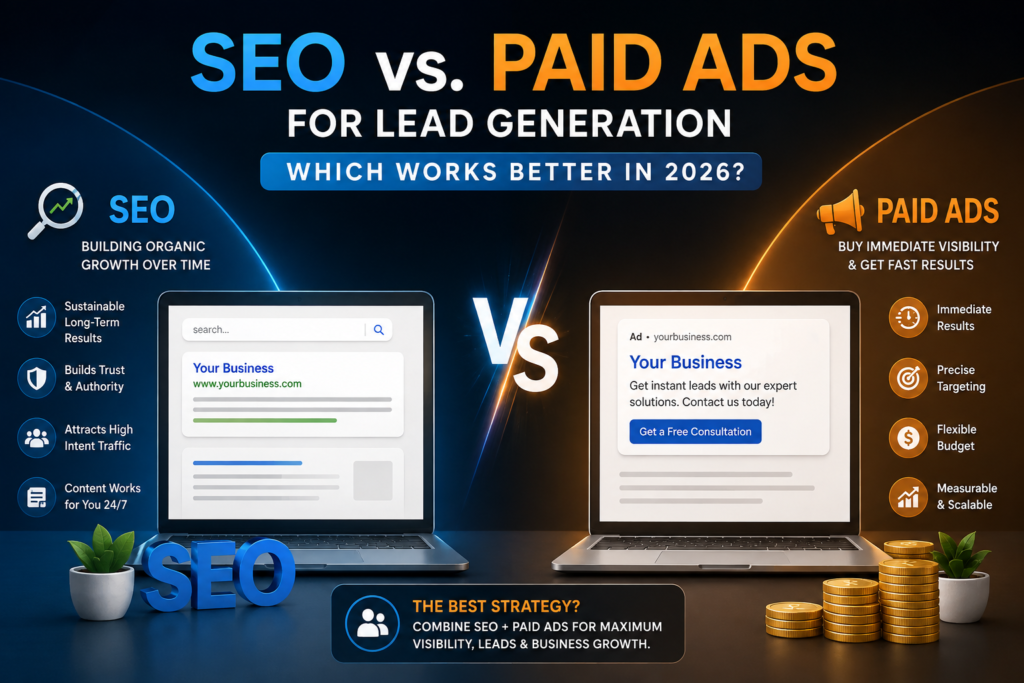
For a deeper look at how different acquisition channels can contribute to lead generation, read SEO vs. Paid Ads for Lead Generation: Which Works Better in 2026?.
2. Your Website Doesn’t Communicate Value Quickly
Visitors don’t spend much time trying to understand what a business does.
When someone lands on your homepage, they should be able to understand three things quickly:
- What do you offer?
- Who is it for?
- Why should they choose you?
If your homepage uses vague statements such as “We deliver innovative solutions” without explaining the actual business outcome, visitors may leave before exploring further.
Your headline should communicate a clear value proposition.
Instead of focusing only on what your company does, explain the problem you solve and the result customers can expect.
Clear positioning reduces confusion.
And reduced confusion can improve conversions.
3. Your Call-to-Action Is Too Weak
A website can have excellent content and still fail to generate leads because the next step isn’t obvious.
Common examples include:
- Contact Us
- Learn More
- Submit
- Get Started
These aren’t necessarily bad CTAs, but they may not provide enough motivation.
A stronger call-to-action connects the action with a benefit.
For example:
Book a Strategy Session
can be more meaningful than simply:
Contact Us
The CTA should also match the visitor’s stage in the buying journey.
Someone discovering your brand for the first time may not be ready to schedule a consultation.
Give them intermediate options such as:
- Download a guide
- Read a case study
- Explore a service
- Watch a webinar
- Subscribe for insights
Conversion is often about creating the right next step, not forcing the final step too early.
4. Your Landing Page Creates Too Much Friction
Imagine a potential customer clicks an advertisement promising a specific solution.
Instead of arriving on a focused landing page, they land on a generic homepage with multiple services, menus, banners and unrelated information.
The visitor now has to figure out where to go.
That creates friction.
A good landing page should have a clear relationship between:
Search/Ad → Message → Landing Page → CTA
If the visitor’s expectation isn’t matched by the page, conversion rates can suffer.
Review your important landing pages and ask:
- Does the headline match the visitor’s intent?
- Is the main benefit obvious?
- Is there one clear primary CTA?
- Is unnecessary information distracting the visitor?
- Can the enquiry process be completed quickly?
5. There Isn’t Enough Trust
People don’t submit their details simply because a company claims to be good.
They need evidence.
Trust signals can include:
- Client testimonials
- Case studies
- Industry experience
- Media mentions
- Certifications
- Results
- Reviews
- Founder expertise
- Clear contact information
This becomes particularly important for consulting, professional services and high-value B2B decisions.
A strong personal brand can also become an important trust asset.
In fact, personal branding is increasingly connected with business growth because customers often want to understand the people behind a company before making a significant buying decision.
For businesses thinking about growth beyond individual marketing campaigns, How to Scale Your Business in 2026: 10 Proven Strategies for Sustainable Growth explores how customer acquisition, systems and sustainable growth need to work together.
6. Your Website Is Generating Leads, But Your Follow-Up Is Slow
Sometimes the website isn’t the problem.
The lead-generation process after the enquiry is.
A visitor submits a form.
Then nothing happens for several hours.
Or the enquiry reaches an inbox nobody monitors regularly.
Or sales receives the lead without enough information to understand the prospect.
By the time someone responds, the potential customer may already be speaking with a competitor.
Businesses should create a clear process for:
Lead → Qualification → Follow-up → Sales Conversation → Proposal → Conversion
Marketing and sales cannot operate as completely separate systems.
The website generates the opportunity, but the organisation has to convert it.
7. You’re Treating Every Visitor the Same
Not every visitor has the same intent.
Some are researching.
Some are comparing providers.
Some are ready to buy.
Others may have discovered your brand for the first time.
Your website should accommodate these different stages.
For example:
Awareness
Provide educational articles, guides and useful resources.
Consideration
Provide comparisons, case studies, testimonials and detailed service information.
Decision
Provide strong CTAs, consultations, demos, pricing information or enquiry forms.
This is where a strong content strategy becomes valuable.
Instead of publishing random articles, build content around the questions customers ask throughout the buying journey.
8. Your Marketing Channels Are Working in Silos
This is one of the biggest problems businesses face in 2026.
SEO is handled separately.
Paid advertising is handled separately.
Social media is handled separately.
The website is treated as another project.
But customers don’t experience your business in separate departments.
Someone might discover you through Google, visit your website, see your LinkedIn profile, read an article, watch a video and then finally contact you.
Every interaction contributes to the decision.
That means your marketing should work as a connected system.
Your SEO attracts relevant visitors.
Your content builds authority.
Your website explains your value.
Your social presence builds familiarity.
Your conversion system captures the enquiry.
Your sales process closes the opportunity.
This is why businesses need to think beyond individual campaigns and start building marketing systems.
How to Fix a Website That Gets Traffic but No Leads
If your website is receiving visitors but generating very few enquiries, don’t immediately conclude that you need more traffic.
Start with a conversion audit.
Step 1: Identify Your Highest-Traffic Pages
Find the pages receiving the most organic and paid traffic.
Then compare traffic against:
- Enquiries
- Conversion rate
- Engagement
- Time on page
- CTA clicks
This will help identify pages that attract visitors but fail to create action.
Step 2: Review Search Intent
Look at the keywords bringing visitors to each page.
Ask:
Is this visitor actually a potential customer?
If not, improving rankings may increase the wrong type of traffic.
Step 3: Improve Your Value Proposition
Make the first section of your important pages extremely clear.
Tell visitors:
What you do + Who you help + What outcome you provide.
Step 4: Strengthen Trust
Add real evidence.
Testimonials, case studies, results, experience and expertise can help visitors feel more confident about taking the next step.
Step 5: Simplify the Conversion Path
Don’t make potential customers search for your contact form.
Make the next step obvious.
Step 6: Connect Marketing With Sales
Track what happens after a visitor submits a form.
A lead is not the end of marketing.
It’s the beginning of the sales process.
The Bigger Problem: Traffic Isn’t the Goal
One of the biggest mistakes businesses make is treating website traffic as the final marketing objective.
Traffic is a metric.
Leads are a business outcome.
Revenue is an even more important outcome.
A better way to think about digital marketing is:
Relevant Traffic → Engagement → Trust → Conversion → Sales → Customer Retention
If one part of this system is weak, increasing traffic alone won’t necessarily solve the problem.
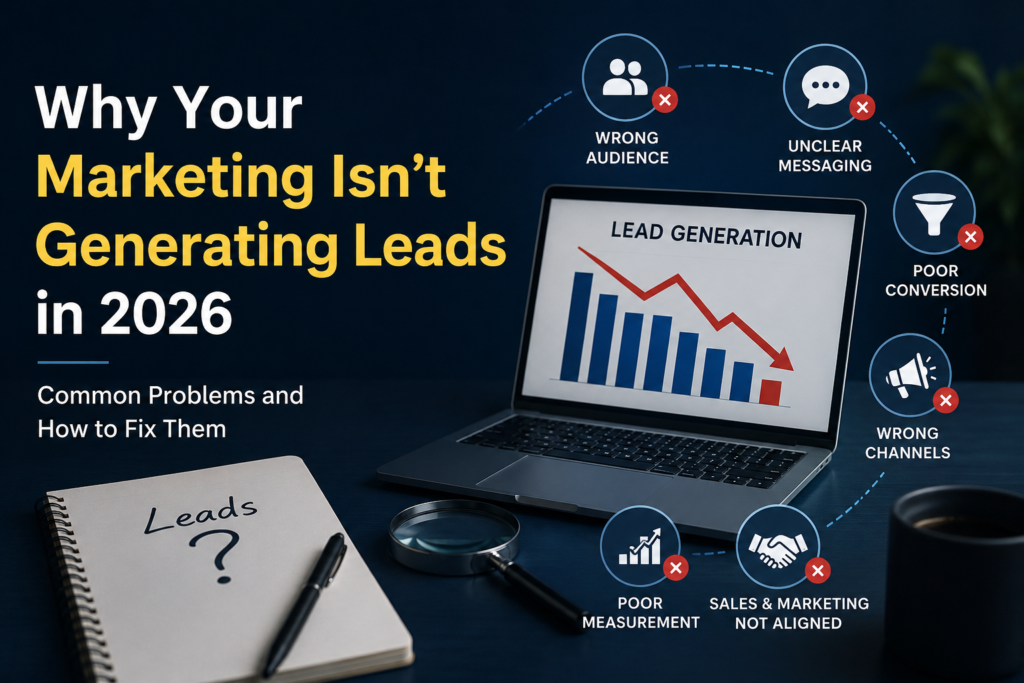
This is also why businesses should periodically review their overall marketing strategy rather than simply increasing their advertising or content budgets. If your marketing activities are generating activity but not business outcomes, understanding Why Your Marketing Isn’t Generating Leads in 2026: Common Problems and How to Fix Them can help identify where the broader strategy may be breaking down.
Final Thoughts
Getting website traffic in 2026 is not enough.
Businesses need to understand who is visiting, why they are visiting, what they see, what they believe and what prevents them from taking action.
A high-traffic website with poor conversion is still leaving significant business value on the table.
Instead of asking:
“How can we get more website visitors?”
start asking:
“How can we turn more of the right visitors into qualified opportunities?”
That shift — from traffic generation to conversion strategy — can fundamentally change how you measure digital marketing performance.
For founders and business leaders looking at the bigger picture, the goal should not be more marketing activity.
It should be a marketing system that consistently contributes to growth, revenue and long-term business value.